Chrono-Displaced Person(CDP)
The Time Traveler's WifeChrono-Displaced Person (CDP) is Alba’s concise name for the time-displacement condition she shares with her father, Henry. The term recasts Henry’s frightening, involuntary episodes as an identity he and his daughter can recognize together: when a teacher is told that Henry is dead but not continuously dead, Alba explains that he is a CDP, like her. The phrase joins a bodily condition to a family resemblance and a way of making sense of a life that repeatedly escapes ordinary chronology.
Meaning and Naming
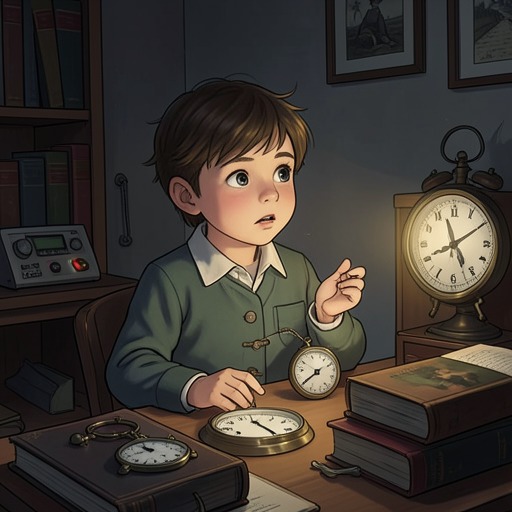
Henry describes time displacement as an illness that he cannot control, not as a chosen power. Its triggers may include exhaustion, loud noises, stress, sudden standing, and flashing lights, but episodes can also interrupt an ordinary moment without warning. He might be reading the Sunday Times beside Clare and suddenly find himself in 1976, watching his thirteen-year-old self mow his grandparents’ lawn. Some displacements last only moments, like a radio losing its station; others place him in unfamiliar crowds or isolated places.
Alba supplies the full phrase, Chrono-Displaced Person, when Henry asks what CDP means. Sitting with him on a bench in front of a Tang Dynasty porcelain dragon, she tells him that she is a CDP too. Henry has never met her before, and she is not yet born in his own present. Her calm self-possession makes the term more than a clinical label: it is a piece of knowledge the daughter possesses about herself and her father, even as the father encounters her for the first time.
The Condition in Daily Life
For Henry, displacement means arriving without clothes, money, or identification. He says that he becomes a desperate version of himself: a thief, a vagrant, an animal that runs and hides. Each episode turns basic survival into immediate work—finding clothing, staying concealed, and navigating a place and time that were not chosen. The gap between an extraordinary phenomenon and its humiliating practical demands is central to his account: he may amaze children and startle old women, but he must also find something to wear.
The condition repeatedly brings Henry into conflict with the police. He says that officers cannot work out why he keeps disappearing while in custody, and that his refusal to identify himself leaves them unaware of where he lives. He has accumulated outstanding warrants for offenses including breaking and entering, shoplifting, resisting arrest, trespassing, indecent exposure, and robbery. He has been arrested seven times, but so far has vanished before the police can fingerprint or photograph him. His nakedness, rather than making him an effective criminal, makes stealth difficult; speed and concealment are the assets he can rely on.
Displacement also intrudes into intimate and professional spaces. Henry can vanish from bed beside Clare and return at dawn with a bleeding mouth, or arrive at the Newberry Library after hours, injured and trapped inside the Cage, the four-story steel structure running through a stairwell. There he faces the prospect that his coworkers will discover what he has kept hidden. The episodes are not only temporal disruptions: they expose him to physical danger, leave evidence on his body, and threaten his ability to maintain an ordinary job and a private life.
Alba and a Shared Identity
Alba uses the term in a moment when an adult’s ordinary account of the world has failed. When a teacher tells Henry that Alba’s father is dead, Alba answers that he is dead but not continuously dead, then identifies him as a CDP like herself. Her explanation makes their unusual condition intelligible to the teacher, who responds sympathetically, even though the label means nothing to Henry at first. Alba squeezes his hand, prompting him to speak; in the scene, naming the condition helps bridge not just a difference in understanding but a difference in time.
Their first conversation makes the shared identity concrete. Henry asks whether they see each other often. Alba says they do not: about a year has passed since her last meeting with him, and she remembers seeing him a few times when she was eight. What is a first encounter for Henry is already part of Alba’s past. CDP therefore names an inherited condition, but it also marks the unequal knowledge produced by their displaced timelines: daughter and father meet with different histories of one another.
Disclosure, Dependence, and Ordinary Life
Henry’s account to his Newberry coworkers expands the meaning of the condition beyond unexplained appearances. After waking injured inside the Cage, he waits for hours, cold and dreading the moment of disclosure. When colleagues arrive, he explains the practical and genetic aspects of time travel, that it is a disease he cannot control, and how it has shaped his life with Clare. His explanation includes causal loops and quantum mechanics, but also lying, stealing, fear, and the effort to have a normal life. He concludes that a normal job is part of that effort; one colleague questions whether the job, or the life, can be called normal.
The effects of the condition continue when Henry loses both feet to frostbite. Unable to get out of bed, he tells Kimy that he has no feet. She insists on helping him into his wheelchair and getting him to the bathroom, which is too narrow for the chair to pass. Later, when Henry teaches Clare to cook, the kitchen’s counters and cabinets are too high for him to use from his wheelchair, so they work together at the table, with him guiding her through the steps. These scenes do not make CDP synonymous with amputation; they show how a life already shaped by involuntary displacement continues through bodily injury, inaccessible spaces, and practical dependence.
Narrative and Thematic Significance
The book’s dated, alternating accounts make the condition felt as a mismatch between event time and lived time. Henry and Clare can share a bed or meet in a library while holding different knowledge of where each stands in their relationship; Henry can encounter a daughter who remembers him from visits that have not yet occurred in his sequence of experience. The term CDP provides a stable name within that instability, but it does not make the chronology orderly or the episodes voluntary.
Alba’s phrase also contrasts with Henry’s earlier sense that displacement turns him into an illusion, a desperate creature surviving one episode at a time. She identifies a person, not merely a spectacle or a medical problem, and places that person within a shared family condition. The name offers recognition rather than a cure: Henry remains subject to unpredictable departures, exposure, danger, and loss, while Alba’s recognition makes their connection across time explicit. For the reader, CDP is both a compact description of the condition and a reminder that its consequences are experienced in bodies, relationships, work, and the effort to inhabit ordinary life.